C+J 2025 AGENDA 

Day One • Thursday, December 11

Multi-Purpose Room, Day One

8:00 AM REGISTRATION and BREAKFAST
9:00 AM OPENING REMARKS
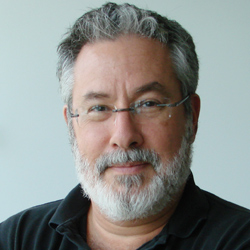
Alberto Cairo, Conference Host, UM School of Communication

Alberto Cairo

Alberto Cairo

At the University of Miami, Dr. Alberto Cairo is the Knight Chair in Visual Journalism and a Professor in the Department of Journalism and Media Management teaching classes on visualization and information graphics, and for the Master of Fine Arts in Interactive Media program. In addition, he is the Director of Visualization at The U’s Frost Institute for Data Science and Computing (IDSC). He holds a BA in Journalism from the Universidad de Santiago de Compostela, and MA and PhD degrees from the Universitat Oberta de Catalunya in Spain. Dr. Cairo has also been a lecturer and professor at Universidad Carlos III de Madrid (UC3M), Universitat Oberta de Catalunya, and the University of North Carolina at Chapel Hill.

Described in a Microsoft profile as always in the vanguard of visual journalism, Cairo’s career has tracked alongside the major technological developments in and out of the newsroom. He served as the Director of Infographics of El Mundo online (Spain, 2000-2005) and Editora Globo (Brazil, 2010-2011), and has consulted with—and organized workshops and other training programs for—media organizations and educational institutions in more than 30 countries. He works as a consultant for organizations such as Google News Initiative, NORC at the University of Chicago, the European Commission, and the Congressional Budget Office.

Cairo is a host at The Data Journalism podcast with Simon Rogers and Scott Klein, and the author of four books:

The Art of Insight: How Great Visualization Designers Think (2023)
How Charts Lie: Getting Smarter About Visual Information (2019)
The Truthful Art: Data, Charts, and Maps for Communication (2016), and
The Functional Art: an Introduction to Information Graphics and Visualization (2012).

In December 2025, Cairo is launching the Open Visualization Academy.org, an open source repository of knowledge about information design and data visualization.

Opening Remarks | Day One 9:00 AM, Multipurpose Room

Sallie Hughes, Journalism and Media Management Department Chair

Sallie Hughes

Sallie Hughes

Sallie Hughes (PhD, Latin American Studies, Tulane University) is a Professor and the Department Chair of Journalism and Media Management at The School of Communication. She was senior research lead and faculty director at the University of Miami Institute for Advanced Study of the Americas from 2016-2021. She teaches courses in comparative journalism and media studies. She coordinates the Latin American region of the Worlds of Journalism Study, the largest cross-national study of journalists’ working conditions, professional values. and occupational epistemologies. She is the author of Newsrooms in Conflict: Journalism and the Democratization of Mexico and co-author of Making a Life in Multiethnic Miami: Immigration and the Rise of a Global City, as well as numerous peer-reviewed academic publications. Her current research interests include the sustainability of journalism, journalism and human rights, and journalist safety, risk and coping.

Opening Remarks | Day One 9:00 AM, Multipurpose Room

9:10 AM KEYNOTE
Attila Bátorfy, Eötvös Loránd University
Talk Title: Data journalism in an illiberal regime

Attila Batorfy

Attila Bátorfy

Attila Bátorfy is a data journalist, media scholar, and professor of journalism and information design at the Department of Media and Communication Studies at Eötvös Loránd University Budapest. Before his academic career, he worked as a journalist for nearly fifteen years. He was previously the head of data at Átlátszó, Hungary’s first investigative journalism outlet. In 2018 he founded with Átlátszó the visual journalism project Átló. He has received numerous awards for his journalistic work. He has published several articles on the authoritarian tendencies and transformation of the Hungarian media system and journalism over the past decade.

TALK TITLE: Data journalism in an illiberal regime

Two decades ago, most evangelists of data journalism proclaimed that an age of facts and reason was coming. We have many reasons to believe that the opposite has happened. While data journalism methods have become increasingly sophisticated and more data has become available, the impact of this type of content has been limited. This is especially true in a country, Hungary, that has had an authoritarian government for a decade and a half. What has worked so far, what has not worked, and what will never work in data journalism in an illiberal country?

10:00 AM COFFEE BREAK
10:30 AM PANEL: AI in Journalism • Moderated by Jeremy Gilbert

Jeremy Gilbert, Knight Professor in Digital Media Strategy, Northwestern University

Jeremy Gilbert

Jeremy Gilbert | Moderator

Jeremy Gilbert’s work and research focuses on the content and revenue strategies of existing and emerging media companies. He explores the intersection of technology and media, employing a human-centered design process to examine how new tools and techniques will affect the creation, consumption, and distribution of media.

Jeremy earned both a bachelor’s and a master’s degree in journalism from Northwestern University’s Medill School of Journalism, Media, Integrated Marketing Communications.


Duy Nguyen, The New York Times

Duy Nguyen

Duy Nguyen

Duy Nguyen is a senior machine-learning engineer on the A.I. Initiatives team at THE NEW YORK TIMES. This is Duy’s second tour at THE TIMES, having worked in Opinion Graphics as part of the 2021-22 fellowship class. Since then, he’s been a data scientist at the Brown Institute’s Local News Lab at Columbia Journalism School, helping local newsrooms use A.I. to solve business and audience problems.

In 2021, he was the lead developer of Gumshoe, an A.I. document ranking tool that is now a widely used DocumentCloud extension.


Meg Heckman, Northeastern University

Meg Heckman

Meg Heckman

Meg Heckman is an associate professor at Northeastern University in Boston where she explores journalism’s past, present and future. She uses a mix of computational and analog methods to uncover hidden media history narratives and revitalize local news.

Her scholarly work has been published in Journalism Practice, Journalism Studies and the Newspaper Research Journal. She also writes regularly for a variety of general interest and industry publications including WBUR Cognoscenti, Politico Magazine, USA Today, Saturday Evening Post, Poynter, Columbia Journalism Review and Nieman Lab.


Bahareh Heravi, University of Surrey, Surrey Institute for People-Centered AI

Bahareh Heravi

Bahareh Heravi

Dr. Heravi is an Associate Professor of AI & Media at the Institute for People-Centred AI at the University of Surrey (UK), and a BRAID Fellow at the BBC, where she leads a project to enhance Responsible AI literacy across the BBC and the wider media sector.

With 25 years’ experience across industry and academia, including 15 years exclusively at the intersection of AI, data, and journalism, she combines high-impact research, academic leadership, and extensive industry expertise. She has worked with leading news and media organisations globally, including BBC, RTÉ, Storyful, The Conversation, Rappler, Cuestión Pública, Agência Pública, and The Irish Times, and has taught and mentored journalists across many outlets. In addition to her academic work, she consults with news organisations on AI strategy, governance, responsible AI guidelines, and policy development, as well as delivering high-impact training for editorial teams and senior leaders, and facilitating cross-team workshops across editorial, technical, and leadership functions.

Dr Heravi is an expert evaluator for the European Commission and the founding Chair of the European Data & Computational Journalism Conference. She is also a visiting fellow at the Microsoft–UCD Centre for Digital Policy, serves on the Irish Government’s Open Data Governance Board, and contributes to national policy discussions in the UK. She has widely published on AI and journalism, data journalism, and data storytelling, frequently gives talks on the use of AI in media and journalism, including a TEDx talk, and occasionally provides expert commentary, including appearances on TV and radio.

Before joining the University of Surrey, Dr Heravi was the founding director of Ireland’s first Data Journalism Programme at University College Dublin and served as Lead Data Scientist at The Irish Times, where she spearheaded the Irish Times’ Data section. Earlier in her career, she spent over a decade in the software industry, designing, developing, and managing information systems across multiple sectors.

She was named among journalism.co.uk’s top expert voices on AI and journalism in 2025. In 2019, she was ​selected for Silicon Republic’s Sci-Tech 100 and named one of “22 high-flying scientists making the world a better place”.

David Chivers, Digital Acceleration Partners

David Chivers

David Chivers

David is the Lead Advisor for The Lenfest Institute for Local Journalism’s AI Collaborative and Fellowship Program, in partnership with Microsoft and OpenAI, and the Founder of Digital Acceleration Partners. He works with leading organizations across media, technology, and consumer industries to advance responsible AI adoption, revenue and audience growth, digital strategy, and organizational transformation.

A seasoned executive, David has held senior leadership roles as president, publisher, and in product, marketing, and strategy at major news organizations. He has advised and collaborated with companies including Meta, OpenAI, Microsoft, Hearst, Dow Jones, Google, and The Baltimore Banner, helping them navigate digital transformation while maintaining trust and sustainability. His expertise spans strategic planning, product development, emerging technologies, market expansion, and organizational design.

Actively engaged in industry-wide initiatives, David is a champion of ethical AI and data-driven decision-making. He partners with newsrooms, founders, CEOs, and boards to develop tools and frameworks that empower journalists, strengthen the news ecosystem, and build sustainable growth for mission-driven organizations worldwide.

12:00 PM LUNCH
1:00 PM TALKS • Accountability Data Journalism | Introduced by Rahul Bhargava
Rahul Bhargava, Assistant Professor, Northwestern University College of Media, Arts, and Design

Rahul Bhargava

Rahul Bhargava

Rahul Bhargava is an educator, designer, and artist working on creative data storytelling and computational journalism in support of social justice and community empowerment. He creates data murals and theatre with communities, award-winning museum exhibits, AI-powered civic technologies with CSOs, and delivers hands-on workshops and keynote talks across the globe. Rahul’s first book, “Community Data: Creative Approaches to Empowering People with Information,” is now available from Oxford University Press. He leads the Data Culture Group at Northeastern University as an Assistant Professor in Journalism and Art + Design.

Suhail Bhat, Assistant Data Editor, USA TODAY
Talk Title: Uncovering conflicts of interest through stock trades

Suhail Bhat

Suhail Bhat

Suhail Bhat is a deputy data editor at USA TODAY, leading the Your Life in Data team, which focuses on writing data-driven stories and building interactive tools. When he is not editing, he works on longer-term projects, collaborating with reporters across the newsroom. Priors: THE CITY, Louisville Public Media, and Reuters News.

TALK TITLE: Uncovering conflicts of interest through stock trades

Using publicly available financial disclosures, USA TODAY found that a significant portion of trades by Cabinet members and senior officials occurred just before market-moving announcements. The timing raises questions about potential conflicts of interest and the need for oversight.

Cherry Salazar, Revson Data Fellow | Civic News Company
Talk Title: Dearth of data != death of data journalism

Cherry Salazar

Cherry Salazar

Cherry Salazar is a Revson Data Fellow at Civic News Company, where she analyzes and visualizes data to drive educationelections, and public health reporting. She is also pursuing an M.A. in Journalism at the Craig Newmark Graduate School of Journalism in New York CIty, where she founded and serves as the first president of the Investigative Reporters and Editors pilot and graduate-only student chapter.

She previously covered campaign finance, social media and disinformation, and attacks against the press for nonprofit newsroom Philippine Center for Investigative Journalism. Before that, she produced award-winning documentaries for ABS-CBN, the Philippines’ largest media network until it was forced off the air under the Duterte administration in 2020.

TALK TITLE: Dearth of data != death of data journalism

Public data serves as both a tool and a battleground for how societies understand themselves. In democratic contexts, data reporting enables transparency by uncovering patterns of corruption or systemic issues. But in backsliding governments, data becomes fragile — manipulated, restricted, or erased.

Comparing experiences in the Philippines and the U.S. reveals how the strength of data systems shapes journalism. In the Philippines, data inaccessibility limits reporting possibilities. Yet, even established democracies like the U.S. face growing pressures that threaten data integrity, showing no system is entirely immune. Despite these obstacles, scarcity sparks creative problem-solving, proving that meaningful data journalism can thrive even in constrained environments.

Carolina Bazante, Founder and Director | Lupa Media
Talk Title: Un Debate Con Lupa (A Debate Under a Magnifier)

Carolina Bazante

Carolina Bazante

Carolina Bazante is an Ecuadorian journalist with a decade of experience in media across Latin America, the United States, and Spain. Specialized in data journalism and disinformation, she has worked as an editor, reporter, and trainer of young journalists. Carolina is the founder and executive director of Lupa Media, an independent organization in Ecuador that combines journalism, education, and artificial intelligence to promote information integrity. She has been a fellow of DW Akademie, the International Center for Journalists (ICFJ), and SembraMedia. Carolina focuses on the intersection of AI, fact-checking, and media literacy, exploring how technology can strengthen truth-based journalism in Latin America.

TALK TITLE: Un Debate Con Lupa (A Debate Under a Magnifier)

Un debate con Lupa was the first live fact-checking streaming experience of a presidential debate in Ecuador, developed by Lupa Media during the 2025 general elections. In a context of growing disinformation, violence, and political pressure on the press, the project combined databases, thematic verification guides, and artificial intelligence tools to fact-check candidates’ statements in real time. The talk will present how this pioneering format was designed and executed, its results and impact, and the lessons it offers to strengthen transparency and public trust in fragile democracies.

2:30 PM COFFEE BREAK
3:00 PM TALKS • Innovation and Research | Introduced by Nicholas Diakopoulos

Nicholas Diakopoulos, Professor, Communication Studies, Northwestern University

Nicholas Diakopoulos

Nicholas Diakopoulos

Nicholas Diakopoulos is a professor in Communication Studies and Computer Science (by courtesy) at Northwestern University where he directs the Computational Journalism Lab and is director of Graduate Studies for the Technology and Social Behavior PhD program. His research focuses on computational journalism, including aspects of automation and algorithms in news production, algorithmic accountability and transparency, and social media in news contexts. He is the author of the award-winning book, Automating the News: How Algorithms are Rewriting the Media, published by Harvard University Press. He received his Ph.D. and M.S. degrees in Computer Science from the School of Interactive Computing at the Georgia Institute of Technology, and his Sc.B. degree in Computer Engineering from Brown University.

Tory Lysik, Media Research Fellow & Computational Journalist, and C.J. Robinson, Research & Reporting Fellow | Tow Center for Digital Journalism
Talk Title: Scraper Factories: Using AI to write fleets of unique scrapers at once

Tory Lysik

Tory Lysik

Tory Lysik is a Media Research Fellow and Journalist Fellow at the Tow Center for Digital Journalism at Columbia University, reporting on AI, misinformation, higher education, and politics.

Before coming to Tow, Tory was a data journalist at Axios, where she developed interactive data visualizations and reported data-driven stories for national audiences. Before that, she worked at Vox as a politics and policy reporter in Washington, D.C., and specialized in statistical analysis of criminal justice and legal proceedings through a Poynter Institute Fellowship at D.C. Witness. Her work has appeared in The Marshall Project, Slate, the Associated Press, and other publications.

At Columbia University, Tory served as a teaching assistant for the geospatial data analysis and mapping techniques course in the M.S. data journalism program. She holds an M.S. in Journalism from Columbia Journalism School and attended the Lede Program, where she specialized in interactive and graphic journalism. She earned dual B.A. degrees in Political Science and Journalism from the University of Colorado Boulder.

Tory is a mentor and awards judge for the Data Visualization Society and a mentor for Investigative Reporters and Editor.

CJ Robinson

C.J. Robinson

C.J. Robinson is a Reporting and Research Fellow at the Tow Center for Digital Journalism. His work at Tow focuses on politics, AI and publishers.

Before journalism, he worked as a senior data analyst at The New York Times, analyzing player data to improve engagement with the Times’ games, and developed custom R packages as a data scientist at Expedia.

In 2025, C.J. graduated with an M.S. in Data Journalism from Columbia Journalism School and completed his B.S. in Economics and B.A. in Political Science at the University of Washington.

TALK TITLE: Scraper Factories: Using AI to write fleets of unique scrapers at once

As official data sources deteriorate, it has become increasingly important for journalists to collect their own data. Scraping content from the open web has traditionally been one way to do that. But collecting data in myriad formats can sometimes require a team of data-journalists to write individual scrapers for every unique website.

That’s why we have built Scraper Factories. Our tool uses LLMs to analyze a website’s structure and take a first pass at writing a Python scraper to extract structured information from the website. Instead of writing custom code for each site, journalists can input a URL and get working scraper code in minutes.

This method has allowed us to generate fleets of scrapers all at once that, for instance, can grab announcements from dozens of different university webpages, allowing us to quickly acquire a corpus of data that would have previously been too time intensive to collect. (While the AI-written scrapers don’t always work perfectly, quickly debugging the scrapers that don’t work has proven much less time-intensive than writing them from scratch). We aim to release this regularly updating dataset in the coming months and plan to utilize it to illuminate the ways in which institutions of higher education are being systematically undermined.

The infrastructure also runs the scrapers daily, performs health checks, and notifies us of changes to the underlying websites. During this talk, we will generate scrapers live for different institutional websites and walk through deployment options. Attendees get the complete open-source codebase and documentation.

Caleb Okereke, Managing Editor, Minority Africa
Talk Title: Can AI Triage a Pitch? A Case Study in Editorial Evaluation from Minority Africa

Caleb Okerere

Caleb Okereke

Caleb Okereke is the Founder and Executive Editor of Minority Africa. He is a Nigerian journalist who has reported across Africa for Aljazeera, CNN, Foreign Policy, VICE News, The Guardian, and NPR. Currently, he is a Journalism PhD student at Northeastern University and a Doctoral Fellow at the Institute for Information, the Internet and Democracy, where his research broadly interrogates the politics of representation in media systems, with a focus on how AI and computational tools mediate visibility, power, and identity.

TALK TITLE: Can AI Triage a Pitch? A Case Study in Editorial Evaluation from Minority Africa

This talk examines the limits and possibilities of automating editorial judgment through the case of Iraka, a custom GPT-based tool developed by Minority Africa to assist with pitch triage. Trained on over 400 anonymized submissions and their corresponding outcomes, Iraka was designed to model decision patterns (approve, reject, needs development), as well as to reflect the tonal and ethical sensibilities embedded in our editorial practice, particularly around originality, framing, and the representation of marginalized voices. I detail how we built the system and evaluated its outputs across two axes: predictive accuracy (Iraka aligned with human decisions in approximately 70% of cases) and discursive alignment (only about 30% of its feedback captured the tone and nuance of human editors).Yet beyond statistical alignment, the tool often faltered in more subtle but consequential ways. It frequently collapsed identity into value, treating the mere presence of a minoritized subject as sufficient reason to commission a piece. Cross-model comparisons with GPT and Gemini further revealed how different systems encode divergent editorial dispositions, some more risk-averse, others more permissive. This case makes clear that tools built for justice-driven newsrooms cannot simply mimic editorial labor and must instead be reimagined with justice as a foundational design principle.


Eryn Davis, Data Journalist & Fellow | Columbia Journalism Investigations
Talk Title: DataTalk: A Conversational Agent for Story Generation in Accountability Reporting

Eryn Davis

Eryn Davis

Eryn Davis is a data journalist and fellow with Columbia Journalism Investigations (CJI), where she investigates patterns of misconduct in state court systems. Prior to CJI, she was a research fellow at the Brown Institute for Media Innovation, where—in partnership with Stanford OVAL and Big Local News—she co-developed DataTalk, an AI-driven newsroom tool that allows journalists to use semantic language to query structured and unstructured data. She has also covered breaking news for The New York Times metro desk.

Before entering journalism, Eryn spent five years as a management consultant advising public and private sector clients on organizational performance and data strategy. She holds an M.S. in Journalism from Columbia University (2024) and a B.S.B.A. from the University of Miami (2016).

TALK TITLE: DataTalk: A Conversational Agent for Story Generation in Accountability Reporting

Drawing on her experience as a data journalist and metro reporter, Eryn Davis will discuss how DataTalk, built on the Semantic Understanding Query Language (SUQL), generates leads from civic datasets that can be verified through shoe-leather reporting. She will show how this conversational agent expands newsroom capacity by lowering the technical barrier to computational reporting and how local deployment gives newsrooms control over sensitive information and analysis at a time when data access and information integrity are increasingly under threat.

Marinanne Aubin Le Quéré, Princeton University, and Michael Krisch, Brown Center for Media Innovation
Talk Title: Mapping the Changing Geography of Local Information: Evidence from North Carolina

Marianne Aubin Le Quere

Marinanne Aubin Le Quéré

Marianne is a postdoctoral fellow Postdoctoral Fellow at Princeton University’s Center for Information Technology Policy and an Incoming Assistant Professor in Information Science at the University of Illinois-Urbana Champaign.

Marianne’s work combines computational social science, social computing, and communication to look at how AI and other emerging technologies impact online news and civic information consumption.


Michael Krisch

Michael Krisch

Michael Krisch is the Acting Director at the Brown Institute for Media Innovation, a bicoastal research center at Columbia Journalism School and Stanford Engineering that reimagines how we find and tell stories. In his role, Krisch oversees a myriad of special projects and grants, including bicoastal collaborations, while also shaping the Institute’s programmatic offerings.

TALK TITLE: Mapping the Changing Geography of Local Information: Evidence from North Carolina

As local newspapers face financial pressures and closures, communities increasingly turn to alternative sources like civil society organizations and online groups for local information. But how has this shift changed what gets covered, and in which communities?

We examine this question by tracking the geographic reach of local content. Using a machine learning pipeline, we identified and mapped locations mentioned in thousands of newspaper articles, civil society organization posts, and online community posts across North Carolina. We use this approach to answer questions like: Are local newspapers covering fewer locations over time? How does geographic coverage differ between newspapers, civil society organizations, and online groups?

To answer these questions, we built an interactive visualization platform called Local(e) to visually map these geographic patterns in local coverage. In this talk, we’ll demonstrate the tool and discuss what it reveals about America’s evolving local information landscape. We welcome collaboration with news organizations and researchers interested in applying this approach to other regions.
.

5:00 PM COFFEE BREAK
5:30 PM KEYNOTE
Kae Petrin, Data + Graphics Reporter, Civic News Co.
Talk Title: Malice & government data: What anti-LGBTQ+ policies mean for journalism

Kae Petrin

Kae Petrin

Kae Petrin is a data journalist and media educator whose work crosses the intersections of government accountability reporting and LGBTQ+ communities coverage. They are a current John S. Knight Journalism Fellow at Stanford University. In 2020, they cofounded the Trans Journalists Association with several dozen fellow journalists. Through four years of volunteer work as a board member and Interim Executive Director, they oversaw the organization’s formalization into a 501(c)(3). Kae now serves on the board as President.

As a Data & Graphics Reporter on Civic News Company’s visuals team, they collaborate with local reporters to tell policy and accountability stories about education, voting rights, and public health. Throughout their career in local news they have contributed analysis and visualizations to reporting recognized by regional and national awards. They also served on the board of directors for the St. Louis Pro chapter of the Society of Professional Journalists from 2017 to 2023.

Kae presents on queer and trans coverage best practices, data reporting and visualization tools, and the collision of these topics for universities, industry conferences, and newsrooms around the U.S.

TALK TITLE: Malice & government data: What anti-LGBTQ+ policies mean for journalism

Abstract: The Trump administration has gone out of its way to obstruct and remove data collections related to LGBTQ+ Americans. In his first term, this looked like interference with the 2020 Census. Now, it involves mass-censoring the word “gender” to “sex” in scientific datasets and removing some of the few repositories of federal data that we have on LGBTQ+ people. The latter sets back years of research and changes to data collection practices that could have informed policy change. Yet, LGBTQ+ data collection has a dark side: Texas, for instance, has attempted to use data as a tool of state power, to separate families from transgender children and to identify Texans seeking out-of-state medical care. How can journalists work with datasets that might seek to actively misrepresent their content? And how can we responsibly illuminate data that may fill in the absences the government is creating?

6:30 PM NETWORKING RECEPTION

Executive Conference Room, Day One

10:30 AM WORKSHOP 1
Andrés Snitcofsky, Lead Project Manager, Cargografias | Information + Interface Designer, Visualizando.ar
Workshop Title: Embodying Data—Storytelling Under Autocracy

Andres Snitcofsky

Andrés Snitcofsky

Andrés Snitcofsky is a graphic designer and data activist from Buenos Aires, Argentina, mainly dedicated to data visualization design. He creates visual stories that make complex political and social issues visible and accessible. Andrés teaches and gives talks and workshops on data storytelling, and has worked in data journalism with Infobae, La Diaria (UY), Chequeado, and other regional media and projects through visualizando.ar.

WORKSHOP TITLE: Embodying Data—Storytelling Under Autocracy

At the “Embodying Data – Storytelling Under Autocracy” workshop, participants will explore how to tell data-driven stories beyond the screen by transforming information into physical and embodied experiences. Working with datasets or testimonies about human rights, censorship, or repression, teams will use their bodies and everyday materials to build collective sculptures, interactive contraptions, or spatial interventions that make the human impact of data visible. Guided step by step from framing to performance, participants will experiment with creative forms of resistance and expression in contexts where traditional narratives may be silenced. The session will conclude with a “performance gallery” showcasing how physical data storytelling can reclaim space, spark empathy, and connect audiences in new ways.

12:00 PM LUNCH
1:00 PM WORKSHOP 2
Bonny McClain, Royal Society of Arts Fellow | Geospatial Analyst, Data Storyteller, Author
Workshop Title: Sustainable and eco-friendly data conversations: co-creating compelling narratives highlighting quantitative storytelling

Bonny McClain

Bonny McClain

Bonny is a dynamic quantitative storyteller facilitating narratives at the intersection of geospatial data science, climate and sustainability. Defying the conventional paths to tech bringing a refreshing perspective to the field blending art and science to convey complex ideas through the power of numbers we are reminded that our first data visualizations are often maps.

Highlighting place and location as memory, audiences explore our interactions with ecosystems revealing that what appears completely factual is often, not factually complete. Recognized as a leading voice in thinking beyond words to illuminate climate science and the human impact on our planetary boundaries, Bonny describes storytelling as where perception and truth create friction. Her expertise transforms raw data into compelling narratives that drive impactful decision-making.

Partnering with organizations to reveal actionable insights to promote environmental responsibility and sustainable practices collaborative engagements reveal actionable insights proving that often, numbers can tell a better story than simply thinking with words.

WORKSHOP TITLE: Sustainable and eco-friendly data conversations: co-creating compelling narratives highlighting quantitative storytelling

This isn’t the marketing side of story – this is the normative and evidence-based side of merging qualitative and quantitative uncertainties to hold tensions in a space designed to mobilize diverse knowledge and value systems.

Although I am a huge advocate of the phrase, “The Map is Not the Territory” I recognize the power of visualizing spatial relationships and minimizing isolated domains such as land-use, water resources, energy, sustainability and built infrastructure in favor of the integrated narratives required for systems thinking.

Let’s work together in real-time to discover the foundational elements of storytelling and test drive a guide to co-creating important narratives using open-source tools and collaborative idea generation.

We will use open-source workflows to introduce attendees to QGIS, open street map (OSM), Blender, Unreal Engine, and other available datasets and tools to do the following:

  • Identify alternative and competing narratives around sustainability and the measure of social metabolism
  • Explore ambiguities and divergent positions with available quantitative data
  • Identify key epistemological uncertainties with regards to existing data and evidence
  • Explore relations between societal and environmental variables across scales
2:30 PM COFFEE BREAK
3:00 PM WORKSHOP 3
Ijeoma Opara, Master’s Student | University of Maryland
Workshop Title: Using generative artificial intelligence (AI) to strengthen local reporting and storytelling

Ijeoma Opara

Ijeoma Opara

Ijeoma Opara is a master’s student at the University of Maryland focusing on using data and technology for investigative and public interest reporting. She has prior experience practicing journalism in Nigeria and has developed a growing interest in exploring how artificial intelligence can ethically be used to support storytelling and accountability reporting.

WORKSHOP TITLE: Using generative artificial intelligence (AI) to strengthen local reporting and storytelling

The workshop equips journalists or journalism students looking to gain experience using AI in the newsroom with skills to summarize large documents, convert them into audio files or videos explainers, easing the pre-reporting process for reporters. It will be an interactive session during which participants will explore the use of AI to extract data from unstructured information while experimenting with tools such as NotebookLM, Google AI Studio and Gemini to perform these tasks. There are advanced technical skills required.

4:30 PM SESSION END

Toll Library, Day One

1:00 PM LIGHTNING TALKS

Alyssa Fowers, Graphics Reporter | The Washington Post
Lightning Talk Title: How to build a dataset (a silly example for a serious topic)

Alyssa Fowers

Alyssa Fowers

Alyssa Fowers is a graphics and data reporter at The Washington Post who covers the economy and (on a good day) dogs. Before joining The Post in 2020, she studied at the University of Miami’s Interactive Media program.

LIGHTNING TALK TITLE: How to build a dataset (a silly example for a serious topic)

When your dataset doesn’t exist—or exists in fragments across many different sources—sometimes you have to build it yourself. This talk uses the unofficial holiday dataset from The Washington Post’s Department of Data as a humorous example to help think through the issues inherent to building any dataset: where the information comes from, whether to err on the side of over- or under-inclusion, how to evaluate your sources, how to automate (ish) deduplication, when to make judgment calls, how to build a rating scale, and more. By the end of the talk, the audience will understand how we know that the least-real holiday during C+J is the Festival of Unmentionable Thoughts, and how to apply that knowledge in more-substantive settings.


John P. Wihbey, Northeastern University and Caleb Okeréké, Managing Editor, Minority Data
Lightning Talk Title: Image selection and the tacit logics of LLMs: Comparing AI and human choice

Caleb Okerere

Caleb Okereke

Caleb Okereke is the Founder and Executive Editor of Minority Africa. He is a Nigerian journalist who has reported across Africa for Aljazeera, CNN, Foreign Policy, VICE News, The Guardian, and NPR.

Currently, he is a Journalism PhD student at Northeastern University and a Doctoral Fellow at the Institute for Information, the Internet and Democracy, where his research broadly interrogates the politics of representation in media systems, with a focus on how AI and computational tools mediate visibility, power, and identity.


John Wihbey

John P. Wihbey

John P. Wihbey is an associate professor at Northeastern University, where he is cofounder of the Institute for Information, the Internet & Democracy and director of the AI-Media Strategies Lab (AIMES). He is author of The Social Fact (2019) and Governing Babel: The Debate over Social Media Platforms and Free Speech—and What Comes Next (2025).


LIGHTNING TALK TITLE: Image selection and the tacit logics of LLMs: Comparing AI and human choice

We present early findings from a study examining how large language models perform one of journalism’s more tacit tasks: selecting images to accompany news stories. Drawing on a dataset of 10,000 articles across six countries, we asked GPT-based models to act as photo editors and compared their selections to those made by humans. The models consistently privileged emotional resonance—suggesting images for their ability to evoke fear, awe, or sympathy—and approached image composition as modular, often proposing visuals as if they were swappable parts. These patterns point toward a logic of spectacularization, in which affective charge is foregrounded as an editorial function, suggesting that LLMs may reconfigure image selection as a process of emotional staging rather than narrative support.


Nozima Muratova, University of Journalism and Mass Communication of Uzbekistan, and Dilfuza Mirzaakhmedova, DataMediaLab, Republic of Uzbekistan
Lightning Talk Title: Water, Data, and Storytelling: A Citizen-Driven Mapping Initiative in Uzbekistan

Nozima Muratova

Nozima Moratova

Dr. Nozima Muratova, DSc in Media & Communication, is an Associate Professor and Head of Science & Innovation at the Uzbekistan Journalism and Mass Communication University.

She serves as the Country Ambassador for Uzbekistan of IAMCR (International Association for Media and Communication Research) and as the Uzbekistan Representative of AMIC (Asian Media and Communication Center). She is also the Founder of the international scientific journal Media and Communication in Central Asia – media-ca.com.


Dilfuza Mirzaakhmedova

Dilfuza Mirzaakhmedova

Dilfuza Media and information integrity expert with extensive experience in disinformation analysis, fact-checking, and data journalism. Leads Factchecknet.uz as Editor-in-Chief, advancing investigative journalism and fact-checking practices in Uzbekistan and Central Asia. Co-founder and Director of the Media Research and Educational Development Center, overseeing projects on media research, narrative monitoring, and data communications. Collaborates with the Modern Journalism Development Center on strengthening journalism development across the region. Work combines research, mentorship, and digital tools to promote media transparency, counter disinformation, and expand public access to trustworthy information.


LIGHTNING TALK TITLE: Water, Data, and Storytelling: A Citizen-Driven Mapping Initiative in Uzbekistan

The SuvMap (suvmap.uz) initiative created Uzbekistan’s first digital “water map” through citizen-driven data collection. Using a Telegram-based crowdsourcing approach, volunteers across all regions submitted geolocated photos and descriptions of local water sources. The verified data were visualized on an interactive online platform, providing an open overview of the country’s water resources. This project demonstrates how data journalism and digital storytelling can empower citizens, foster transparency, and support evidence-based water management in a context with limited public data access.


Klil Eden, Head of Engineering | Organized Crime and Corruption Reporting Project (OCCRP) + Ezana Ćeman, Product Manager, Organized Crime and Corruption Reporting Project
Lightning Talk Title: Investigative knowledge generation and management with OCCRP Aleph

Placeholder Photo

Klil Eden

Klil Eden is a technologist working with organizations to develop robust, data-intensive investigative software and tech capacity for strategic projects, including digital defense. His work supports organizations in MENA, Europe, and the Americas. Currently, Klil is the Head of Engineering (Data Platforms) at the Organized Crime and Corruption Reporting Project, leading a cross-functional team developing AI-powered influence mapping applications. He is also a fellow at the Center for Digital Resilience.

Ezana Ćeman is a product manager focused on building investigative data platforms that support cross-border journalism and civic accountability. At the Organized Crime and Corruption Reporting Project, she leads the product strategy for tools like Aleph—used by thousands of journalists to uncover corruption and follow the money. Her work spans UX, stakeholder engagement, and roadmap development across technical and editorial teams. Ezana brings experience at the intersection of technology, transparency, and equity, and is passionate about creating user-centered tools that serve the public interest. She is also co-founder and head of digital education at FemLab, a Sarajevo-based NGO advancing gender equality and digital rights. Ezana holds degrees in information systems and IT, and has been recognized as a Grace Hopper Scholar and a Forbes 30 Under 30 Scholar.

Lightning Talk Title: Investigative knowledge generation and management with OCCRP Aleph

In a world increasingly shaped by secrecy, corruption, and misinformation, truth requires infrastructure. The Organized Crime and Corruption Reporting Project (OCCRP) is a global network of investigative journalists working to expose power and hold it accountable. Our investigations have led to over $10 billion in fines and assets seized, 430 official investigations, 736 indictments and arrests, and 135 resignations or sackings. Behind much of that impact is a data platform designed to uncover what others want to keep hidden. Aleph is OCCRP’s investigative tool built to help users follow the money and uncover complex networks across diverse data sources. It holds more than four billion documents, including corporate records, public registries, sanctions lists, court filings, and leaked datasets. Users can upload messy document dumps, extract what matters, generate entities, build network diagrams, and collaborate with other investigators.
This session will discuss the technical methods and editorial frameworks that inform Aleph’s treatment of investigative data:

  • We will discuss how OCCRP’s engineers and data journalists think about collecting, validating, maintaining, and sharing investigative knowledge, including a limited discussion of our usage of LLMs
  • We will discuss, in accessible, conceptual terms, the technical infrastructure that enables our knowledge base.
  • We will share examples of reporting that relied on our tools, including a short demo.
  • Lastly, we will speak about the tight-knit community that Aleph serves that spans newsrooms, research collectives, watchdog groups, OSINT practitioners, and more.

Grace Jennings, Pre-Doctoral Researcher | University of Pennsylvania CSS Lab
Lightning Talk Title:The White House Media: Tracking the Administration’s News and Narrative Strategy

Grace Jennings

Grace Jennings

Grace Jennings is a Predoctoral Researcher with the Computational Social Science Lab at the University of Pennsylvania. She maintains and expands the large-scale data infrastructure of the Penn Media Accountability Project, contributing to research on identifying bias and narratives in mainstream media and science communication. Her work focuses on how data-driven algorithmic systems shape social systems and public discourse. Before joining the CSSLab, she worked as a software engineer at Microsoft on their graphics compiler team.

LIGHTNING TALK TITLE: The White House Media: Tracking the Administration’s News and Narrative Strategy

During the Trump administration, the White House adopted a new approach to its official media communication, launching The White House Wire, a news aggregator curated by the administration. This site presents administration-authored content alongside selected articles from mainstream media outlets, blurring the boundary between government communication and journalism. This project introduces a dataset documenting both the administration’s authored media and the content featured on their platform, to describe the information ecosystem that the Trump administration has constructed and compare this to the broader mainstream media landscape. By examining how state media shapes and circulates narratives, we highlight the growing convergence between political communication and journalism—and the implications for transparency, trust, and independent media.

2:30 PM COFFEE BREAK
3:00 PM PAPER PRESENTATIONS
McKenzie, Tyler R.; Kunjar, Sharaj; Hasegawa Smith, Alyssa; Trujillo, Milo Z.; Foucault Welles, Brooke; Lange, Robin A.
Boardman Ndulue, Emily; Bhargava, Rahul; Dsouza, Vivica
Hernández Méndez, David
Hagar, Nick
Hagar, Nick; Diakopoulos, Nicholas; Agustianto, Wilma
Hagar, Nick; Diakopoulos, Nicholas; Gilbert, Jeremy
5:00 PM COFFEE BREAK


C+J 2025 AGENDA

Day Two • Friday, December 12

Multi-Purpose Room, Day Two

8:00 AM REGISTRATION and BREAKFAST
9:00 AM OPENING REMARKS
Karin Wilkins, Dean, UM School of Communication

Karin Wilkins

Karin Wilkins

Karin Wilkins is Dean of the School of Communication at the University of Miami. Before coming to UM in September 2019 she was Associate Dean for Faculty Advancement and Strategic Initiatives with the Moody College of Communication at the University of Texas at Austin, where she also held the John T. Jones Jr. Centennial Professorship in Communication and the John P. McGovern Regents Professorship in Health and Medical Science Communication. She was awarded the Cale McDowell Award for Innovation in Undergraduate Studies, for creating a certificate in global studies, programs in Middle East studies, and a degree in Communication and Leadership.

Wilkins is also the Editor-in-Chief of Communication Theory. She has won numerous awards for her research, service and teaching, and chaired the Intercultural Development Division of the International Communication Association. Her work addresses scholarship in the fields of development communication, global communication, and political engagement. She holds a Ph.D. and a Master in Communication from the University of Pennsylvania and a B.A. in Interdisciplinary Studies from Bucknell University.

Opening Remarks | Day Two 9:00 AM, Multipurpose Room

9:10 AM KEYNOTE
Homa Hosseinmardi, University of California, Los Angeles
Talk Title: Overexamined Algorithms and Overlooked Agency: Rethinking Online Harm

Homa Hosseinmardi

Homa Hosseinmardi

Homa is an Assistant Professor of Data Science (DataX) and Computational Communication at UCLA, where she directs the OASIS Lab (Online and AI Systems’ Integrity & Safety). Her research takes a holistic, large-scale approach to understanding sociotechnical systems and information ecosystems, with a focus on safety and trustworthiness.

She serves as an editor for the Journal of Quantitative Description: Digital Media, received the “Outstanding Research Award” during her Ph.D., and co-founded the CyberSafety workshop series. Her work has been featured in major media outlets and published in over 30 peer-reviewed papers, including top venues such as PNAS, Science Advances, TKDE, and IMWUT.

TALK TITLE: Overexamined Algorithms and Overlooked Agency: Rethinking Online Harm

In recent years, critics of online platforms have raised concerns about the ability of recommendation algorithms to amplify problematic content with potentially radicalizing consequences. Yet most attempts to evaluate these claims suffer from a core methodological gap: the absence of appropriate counterfactuals—what users would have encountered without algorithmic recommendations—making it difficult to disentangle the influence of the algorithm from users’ own intentions.

To address this challenge, we first examined the scale of the problem and possible explanations. While we identified several distinct communities of news consumers within YouTube, from moderate to more extreme, we found little evidence that the YouTube recommendation algorithm is actively driving attention to problematic content. Overall, our findings indicate that trends in video-based political news consumption are determined by a complicated combination of user preferences, platform features such as recommendation systems, as well as the supply-and-demand dynamics of the broader web.

We propose a novel method called “counterfactual bots,” which enables us to disentangle the role of the user from platform features on the consumption of highly partisan content. By comparing bots that replicate real users’ consumption patterns with counterfactual bots that follow rule-based trajectories, we show that, on average, relying exclusively on the recommender results in less partisan consumption, with the effect being most pronounced for heavy partisan consumers.

10:00 AM COFFEE BREAK
10:30 AM TALKS • Journalism and Autocratic Power | Introduced by Rahul Bhargava

Rahul Bhargava, Assistant Professor, Northwestern University College of Media, Arts, and Design

Rahul Bhargava

Rahul Bhargava

Rahul Bhargava is an educator, designer, and artist working on creative data storytelling and computational journalism in support of social justice and community empowerment. He creates data murals and theatre with communities, award-winning museum exhibits, AI-powered civic technologies with CSOs, and delivers hands-on workshops and keynote talks across the globe. Rahul’s first book, “Community Data: Creative Approaches to Empowering People with Information,” is now available from Oxford University Press. He leads the Data Culture Group at Northeastern University as an Assistant Professor in Journalism and Art + Design.

Andres Snitcofsky, Lead Project Manager, Cargografias | Information + Interface Designer, Visualizando.ar
Talk Title: Visualizing Absence: Data storytelling when the numbers are missing in the context of enforced disappearance

Andres Snitcofsky

Andrés Snitcofsky

Andrés Snitcofsky is a graphic designer and data activist from Buenos Aires, Argentina, mainly dedicated to data visualization design. He creates visual stories that make complex political and social issues visible and accessible. Andrés teaches and gives talks and workshops on data storytelling, and has worked in data journalism with Infobae, La Diaria (UY), Chequeado, and other regional media and projects through visualizando.ar.

TALK TITLE: Visualizing Absence: Data storytelling when the numbers are missing in the context of enforced disappearance

How can we visualize what is not there—data that is incomplete, erased, or deliberately hidden by authoritarian regimes? This talk explores that question through the work of the Argentine Forensic Anthropology Team (EAAF) and La Búsqueda, a project documenting the identification of victims of enforced disappearance during Argentina’s last dictatorship. As part of the design team, we faced the challenge of representing absence itself: missing identities, silenced families, and destroyed records. Drawing from this and similar cases across Latin America, the talk reflects on strategies for visualizing uncertainty and loss, honoring dignity while exposing evidence, and creating data narratives when information has been systematically suppressed.

Ilia Veniavkin, Researcher + Content Editor/Producer, Bard College
Talk Title: Blueprints for Outlasting Media Erasure: Scaling Russian Independent Media Archive

Ilia VEnyavkin

Ilia Veniavkin

Ilia Veniavkin  is an historian, civic educator, and a journalist. For 15 years he has been studying Stalinist culture and subjectivity. He wrote an ebook, Master’s Inkwell. A Soviet Writer Inside the Great Purge and co-founded Prozhito.org, a collaborative online archive of Soviet diaries and ego-documents. He is a co-founder of the Russian Independent Media Archive; a scholar at Bard College (United States); and in 2025 has written a book on the ideology of Putinism—The Temple of War: People and Ideas that Made Russia’s Invasion of Ukraine Possible (in Russian)

TALK TITLE: Blueprints for Outlasting Media Erasure: Scaling Russian Independent Media Archive

Authoritarians erase independent journalism fast—and predictably. This case of the Russian Independent Media Archive (RIMA), a civic tech project created by independent journalists in exile, spotlights what actually happens when outlets are blocked or deleted, and how to resist. We open with the threat model—how newsroom takedowns spike around key events, how time determines what survives, and where coverage gaps persist. Then we show RIMA’s rapid-response pipeline—alert → capture → verify → provide access → make-findable. The core idea: archives aren’t cold storage; they power journalism, and advocacy now. Our demonstrations will show participants how to prepare for authoritarian erasure of journalism in their home countries and hear real results from our pilot digital archive in Russia and another case study in Central America. We’ll also share a portability kit that outlines a set of roles, budget line items, training modules, and a risk checklist to organize this project in your community.

12:00 PM LUNCH
1:00 PM TALKS • Education, Collaboration, and Outreach | Introduced by Larry Birnbaum

Larry Birnbaum, Professor of Computer Science | Northwestern University McCormick School of Engineering

Larry Birnbaum

Larry Birnbaum

Larry Birnbaum’s research and teaching focus on applied AI and human-AI collaboration. He and his students develop, study, and apply new technologies in natural language processing (NLP), conversational interfaces, intelligent information systems, social media data analytics, machine learning, and computational journalism and media. Key areas of research include methods for the automatic generation of content by machine, including specifically the automatic generation of narratives from data, and on natural human-AI collaboration via conversational interaction. Larry’s research also spans intelligent information systems, including models of automatic and contextual search and information diversity; preference predication and recommendation using social media data; and applications of AI to journalism and media.

Bonny McClain, Royal Society of Arts Fellow | Geospatial Analyst, Data Storyteller, Author
Talk Title: Decoding Climate Science with Open Data Resources: What AI’s Energy Needs Mean for Our Planet

Bonny McClain

Bonny McClain

Bonny is a dynamic quantitative storyteller facilitating narratives at the intersection of geospatial data science, climate and sustainability. Defying the conventional paths to tech bringing a refreshing perspective to the field blending art and science to convey complex ideas through the power of numbers we are reminded that our first data visualizations are often maps.

Highlighting place and location as memory, audiences explore our interactions with ecosystems revealing that what appears completely factual is often, not factually complete. Recognized as a leading voice in thinking beyond words to illuminate climate science and the human impact on our planetary boundaries, Bonny describes storytelling as where perception and truth create friction. Her expertise transforms raw data into compelling narratives that drive impactful decision-making.

Partnering with organizations to reveal actionable insights to promote environmental responsibility and sustainable practices collaborative engagements reveal actionable insights proving that often, numbers can tell a better story than simply thinking with words.

TALK TITLE: Decoding Climate Science with Open Data Resources: What AI’s Energy Needs Mean for Our Planet

Through multidisciplinary analysis encompassing economic, social, demographic, biophysical and ecological variables, we unravel the metabolic patterns of cities. Utilizing open source solutions integrated with satellite imagery we will visualize data, maps and interactive graphics spotlighting the built infrastructure as the crucial interface between production, consumption, and the energy required to further our questionable “growth at any cost” world narrative.

Ata Aydin Uslu, PhD Student | Northeastern University Network Science Institute, and John Wihbey, David Lazer, Katherine Ognyanova, Matthew A. Baum, Mauricio Santillana, Roy H. Perlis, Hong Qu, James N. Druckman
Talk Title: From Surveys to Stories: The CHIP50 Project as a Data Collaboration Model for Academics and Journalists

Ata Aydin Uslu

Ata Aydin Uslu

Ata Aydin Uslu is a computer scientist and a 6th year Ph.D. student in network science working with David Lazer, studying the societal impacts of artificial intelligence and social networks. His research combines large-scale data analysis, surveys, and generative agent modeling to understand technology adoption and online behavior. He has published in JAMA Network Open, Nature Human Behavior, Neuropsychopharmacology, and is currently a researcher in the CHIP50 project, with his work featured in outlets such as The New York Times and The Washington Post. He graduated Magna Cum Laude with a double major in Computer Science and Electrical Engineering at Koç University with a full scholarship. Previously, he led the IT governance and cybersecurity team for a global airline for two years and provided consulting and auditing for IT projects in terms of cybersecurity, privacy, and regulation compliance.

TALK TITLE: From Surveys to Stories: The CHIP50 Project as a Data Collaboration Model for Academics and Journalists

This talk presents the CHIP50 Project as a model for data collaboration between academics and journalists. Originally designed to track public health and institutions during COVID-19, CHIP50 has evolved into a scalable survey infrastructure that has supported newsroom partnerships. Through collaborations with outlets like The Haitian Times, The Forward, and The Georgia Asian Times, CHIP50 illustrates how academic data systems can expand journalistic capacity and strengthen data-informed reporting.

Simran Parwani, Data Visualization Designer and Developer
Talk Title: Inclusive Pedagogies for Data Journalism: Reflection, Resistance, and Empathy

Simiran Parwani

Simran Parwani

Simran likes asking questions and making charts–in that order. She has produced data experiences for a wide range of contexts and teams from the Census Bureau to FiveThirtyEight to Axios. She loves the intersection of dataviz and community-building, teaching the course “Data Visualization and Communication” at the University of Vermont and contributing to the Data Visualization Society as a former board member.

TALK TITLE: Inclusive Pedagogies for Data Journalism: Reflection, Resistance, and Empathy

In the face of disappearing datasets, sweeping misinformation, and crumbling public distrust, telling the truth with data has never been more urgent. This talk explores how I designed an inclusive, practice-oriented data journalism course that prepares students to navigate this turbulent landscape with critical thinking and empathy.

In this talk, attendees will learn how to break data storytelling projects into reflective, incremental exercises and embed inclusive classroom practices in the context of data journalism education.
.

2:30 PM COFFEE BREAK
3:00 PM KEYNOTE
Yevheniia Drozdova, Texty.org.ua (Kyiv, Ukraine)
Talk Title: Guiding Through the Fog: Media’s Role in Narrative Wars

Yevheniia Drozdova

Yevheniia Drozdova

Yevheniia iholds a Master’s degree in Media and Communications and began her career in a local newspaper. In 2017, she joined the independent Ukrainian media outlet Texty.org.ua, where she now leads the Data Journalism Section. She is passionate about anthropological stories and often works with satellite imagery to explore social and geopolitical issues.

Since 2023, Yevheniia has served as a jury member for The Sigma Awards, an international data journalism competition. She also enjoys creating interactive data stories that make complex issues accessible to wider audiences.

TALK TITLE: Guiding Through the Fog: Media’s Role in Narrative Wars

In today’s complex information landscape, simply debunking individual fakes is no longer sufficient. Readers need a compass — an approach that helps them navigate competing narratives and understand the intentions behind them.

Texty.org.ua embodies this approach as an independent Ukrainian data journalism outlet. Since 2014, the team has focused on studying disinformation and manipulation in the information space, combining traditional journalism with machine learning and natural language processing. Even before AI became mainstream, Texty was already using these technologies to create large-scale interactive projects that make complex topics accessible to broad audiences.

What challenges arise when preparing such investigations, and is the audience ready to engage and understand them? These are some of the questions we will address.
Texty’s work has earned international recognition, including The Sigma Awards along with multiple European and Ukrainian journalism honors. In 2025, Texty won a Sigma Award for a project that examined manipulations in Telegram channels popular in Ukraine.

4:00 PM CLOSING REMARKS
Alberto Cairo, Conference Host, UM School of Communication

Alberto Cairo

Alberto Cairo

At the University of Miami, Dr. Alberto Cairo is the Knight Chair in Visual Journalism and a Professor in the Department of Journalism and Media Management teaching classes on visualization and information graphics, and for the Master of Fine Arts in Interactive Media program. In addition, he is the Director of Visualization at The U’s Frost Institute for Data Science and Computing (IDSC). He holds a BA in Journalism from the Universidad de Santiago de Compostela, and MA and PhD degrees from the Universitat Oberta de Catalunya in Spain. Dr. Cairo has also been a lecturer and professor at Universidad Carlos III de Madrid (UC3M), Universitat Oberta de Catalunya, and the University of North Carolina at Chapel Hill.

Described in a Microsoft profile as always in the vanguard of visual journalism, Cairo’s career has tracked alongside the major technological developments in and out of the newsroom. He served as the Director of Infographics of El Mundo online (Spain, 2000-2005) and Editora Globo (Brazil, 2010-2011), and has consulted with—and organized workshops and other training programs for—media organizations and educational institutions in more than 30 countries. He works as a consultant for organizations such as Google News Initiative, NORC at the University of Chicago, the European Commission, and the Congressional Budget Office.

Cairo is a host at The Data Journalism podcast with Simon Rogers and Scott Klein, and the author of four books:

The Art of Insight: How Great Visualization Designers Think (2023)
How Charts Lie: Getting Smarter About Visual Information (2019)
The Truthful Art: Data, Charts, and Maps for Communication (2016), and
The Functional Art: an Introduction to Information Graphics and Visualization (2012).

In December 2025, Cairo is launching the Open Visualization Academy.org, an open source repository of knowledge about information design and data visualization.

Closing Remarks | Day Two 4:00 PM, Multipurpose Room


Executive Conference Room, Day Two

10:00 AM COFFEE BREAK
10:30 AM WORKSHOP 4
Rui Barros, Data Journalist, PUBLICO
Workshop Title: AI Agents: License to Do Journalism

Rui Barros

Rui Barros

Rui Barros is a data journalist at PÚBLICO, Portugal, where he works on data-driven investigations and interactive storytelling. His work includes cross-border investigative projects examining government accountability and political financing across Europe, collaborating with international newsrooms to make complex data accessible to broad
audiences.

Rui teaches data journalism and web development at Universidade Lusófona and leads workshops at conferences across Europe, focusing on emerging approaches that combine traditional investigative rigor with new technical possibilities—from interactive narratives to AI-assisted research workflows. His work has been recognized with Sigma Awards nominations and the Data Journalism Award from the Portuguese Statistical Society.

WORKSHOP TITLE: AI Agents: License to Do Journalism

Learn to build sophisticated AI agents that handle complex investigative research, cross-reference datasets automatically, and fact-check claims in real-time. This hands-on workshop introduces six proven agent architectures—Prompt Chaining, Routing, Parallelization, and Orchestrator-Workers—that solve real newsroom challenges.

Participants will build practical “AI recipes” to extract and verify statistics from documents, cross-reference claims across databases, route breaking news intelligently, and orchestrate fact-checking workflows with human oversight. Each pattern includes working code, ethical considerations, and integration strategies for existing newsroom tools.

No advanced programming required—just curiosity about how AI can augment journalistic judgment and rigor.

12:00 PM LUNCH
1:00 PM WORKSHOP 5

Robert Simmon, Cartographer + Science Communicator specializing in Visualizing Satellite Imagery
Workshop Title: Data Mapping like a Pro: Raster Maps with command-line tools

Robert Simmon

Robert Simmon

Rob is a cartographer and science communicator who specializes in visualizing satellite data. He has decades of experience working with remote sensing experts and entrepreneurs, helping share their research and products with the public. Along the way he’s designed some of the most widely viewed imagery of our home planet. His work has appeared in newspapers, magazines, and web sites; including the front page of the New York Times and the cover of National Geographic. He’s also known for creating the first global view of the Earth at Night, crafting the Blue Marble featured on the original Apple iPhone, and writing about best practices for scientific visualization.

WORKSHOP TITLE: Data Mapping like a Pro: Raster Maps with command-line tools

Raster data is a powerful tool for telling stories about both the natural world and human conflicts. Unfortunately, working with this data is often difficult and time consuming. In this workshop you’ll use command-line tools like GDAL and Python to read and manipulate raster data formats, and learn the fundamentals necessary to explore new data on your own. These techniques can help you make better and more innovative maps, faster.

2:30 PM COFFEE BREAK


Toll Library, Day Two

10:30 AM PAPER PRESENTATIONS
Hassan, Naeemul; Oates, Sarah; Li, Wei-Ping; and Flores, Alejandro “Alex”
Aubin Le Quéré, Marianne
Salama, Mohamed
Hayes, Cassandra and Kee, Kerk F.
Rony, Md Main Uddin and Hassan, Naeemul
12:00 PM LUNCH
1:00 PM PAPER PRESENTATIONS
Prompol, Kanatip; Jitkajornwanich, Kulsawasd
Dorr, Timothy and Howland, Baird
Mitova, Eliza
Kraishan, Obada; Jitkajornwanich, Kulsawasd; Kee, Kerk F.
Piekarski, Rafal
2:30 PM COFFEE BREAK